Last Updated on August 20, 2026
“Dengue is a bread and butter. Every doctor must know dengue from front till the end”
Introduction
• Dengue must be identified and risk-stratified early
• Dengue is a notifiable disease
Pathogen
• Dengue virus (single-stranded RNA virus, from Flavivirus genus)
• Intrinsic incubation: 4 – 7 days, up to 14 days (viraemic period, may be asymptomatic)
Warning signs of dengue
Warning signs suggest high possibility of complications in dengue infection / rapid progression into
severe dengue
Criteria for Severe Dengue
- (unprovoked)
Mucosal bleeding
×
e.g. epistaxis, gum bleeding, PV bleeding
- Persistent vomiting (≥3 times over 24 hours)
- Abdominal pain / tenderness
- Tender liver
- Persistent diarrhoea (≥3 times over 24 hours)
- Lethargy / confusion / restlessness
- Laboratory: ↑HCT with rapid ↓Platelet count
Diagnosis of dengue
(A) Probable dengue
- Live in
dengue area
×
endemic / hotspot / outbreak area
- Fever with ≥2 other
(B) Laboratory-confirmed dengue
e.g. Dengue rapid combo test / Dengue serology
Classification of dengue
- Dengue ± warning signs
-
Severe dengue
×Severe dengue
Criteria for Severe Dengue
- Severe plasma leakage, leading to shock / respiratory distress
- Severe bleeding, as evaluated by clinician
- Severe organ involvement — Liver ALT or AST ≥1000 // Impaired consciousness // Involvement of heart or other organs
Pathophysiology
• Dengue virus impairs endothelial cell adhesion and tight junction → vascular hyperpermeability → leakage of plasma into extravascular compartment (i.e. 3rd space loss) → haemoconcentration, hypovolaemic shock
• Abnormal haemostasis (thrombocytopenia / coagulopathy)
• Stimulation of cytokines and other inflammatory mediators →
=====
Further reading
1. https://journals.plos.org/plospathogens/article?id=10.1371/journal.ppat.1008603
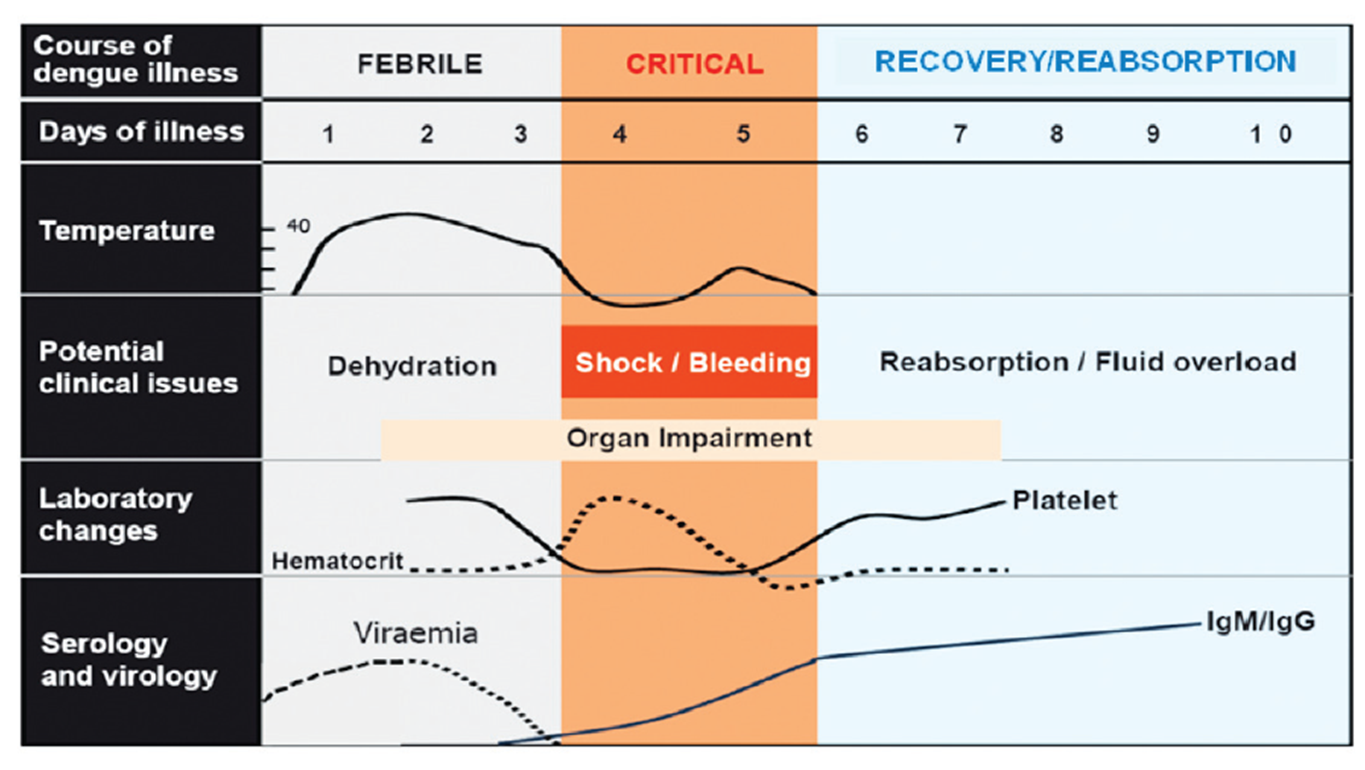
Phases in dengue
Febrile phase
- High grade fever lasting 2 – 7 days + facial flushing, rash, generalised body ache, vomiting, headache, sore throat,
eye redness
×
Conjunctival injection
- Mild haemorrhagic manifestation e.g. petechiae /
mucosal membrane bleeding
×
e.g. gum bleeding, per vaginal bleeding (rarely massive), GI bleeding
- May have
liver tenderness
×
A dengue warning sign
=====
Change in blood parameters
- Earliest FBC change: progressive decreasing
WCC
and low platelet count×WCC
Critical phase
- Onset: Often occurs
after 3rd day of fever
OR indicated by rapid drop in temperature×
but may occur earlier
- Duration: 24 – 48 hours
- In
severe dengue
infection, patient may deteriorate×Severe dengue
Criteria for Severe Dengue
- Severe plasma leakage, leading to shock / respiratory distress
- Severe bleeding, as evaluated by clinician
- Severe organ involvement — Liver ALT or AST ≥1000 // Impaired consciousness // Involvement of heart or other organs
×i.e. 3rd space plasma leakage / organ dysfunction
- Most patients recover spontaneously or require short period of fluid and electrolyte therapy; but some patients may develop compensated / decompensated shock due to plasma leakage
-
Organ dysfunction
usually but not exclusively occurring in this phase×
e.g. hepatitis, encephalitis, myocarditis
=====
Changes in blood parameters that are usually observed:
- FBC: haemoconcentration, thrombocytopenia, leucopenia with relative lymphocytosis
- LFT: elevation of transaminases (typically AST > ALT), hypoproteinaemia, hypoalbuminaemia
Recovery phase
- Onset: after 24 – 48 hours of critical phase
- Plasma leakage stops, followed by reabsorption of extravascular fluid → haemodilution
- Patient’s general wellbeing improves — appetite returns, GI symptoms improve, diuresis ensues
- Haemodynamics stabilise
- May have classical rash — ‘isles of white in the sea of red’
- In some condition,
organ dysfunctions
may worsen×
e.g. hepatitis, encephalitis, intracranial bleed
=====
Changes in blood parameters that are usually observed:
- FBC: Haematocrit stabilises, then drops further due to
haemodilution
; WCC×
Haemodilution occurs due to reabsorption of extravascular fluid during recovery phase
recovery followed by platelet count recovery×WCC
Plasma leakage
Plasma leakage → hypovolaemia → reflex tachycardia & generalized vasoconstriction
Manifestations of vasoconstriction
Differential Diagnoses
• Malaria
• Leptospirosis
• Typhoid fever
• COVID 19
Physical Examination
Haemodynamics
Brain, cardiovascular, lungs, kidney, skin
Normal Circulation | Compensated Shock | Decompensated / Hypotensive Shock | |
Consciousness level | Clear & alert | Clear (may be missed if you do not touch patient) | Change of mental state - restless / drowsy |
Temperature of extremities | Warm & pink | Cold | Cold clammy extremities |
Capillary refill time (CRT) | Brisk (<2 seconds) | Prolonged (>2 seconds) | Mottled skin, very prolonged CRT |
Peripheral pulse volume | Good volume | Weak & thready pulses | Feeble / Absent |
Heart rate | Normal | Tachycardia | Severe tachycardia // bradycardia in late shock |
Blood pressure | Normal | - Normal
SBP
Abbreviation: SBP • Systolic blood pressure • Spontaneous bacterial peritonitis Abbreviation: DBP • Diastolic blood pressure -
Postural hypotension
Postural hypotension: https://www.myhouseman.my/hypotension/ | Hypotension / Unrecordable BP |
Pulse pressure | Normal | Narrowing pulse pressure | Narrowed (≤20 mmHg) / Unrecordable |
Respiratory rate | Normal | Tachypnoea | Metabolic acidosis / Hypernoea |
Urine output | Normal | Reducing trend | Oliguria / Anuria |
Investigations
Full blood count (FBC)
- Progressive decrease in
WCC
followed by platelet reduction is×WCC
White cell count Mnemonic:
• Leucopenia with relative lymphocytosis can be usually observed during critical phase
• Leucocytosis + dengue shock may suggest plasma leakage / bleeding, rather than secondary bacterial infection
Haematocrit
Median normal values
Lady f(fourty)irst — 0, 2, 4, 6
• Female — 40%
• Male — >60 years old = 42%; ≤60 years old = 46%
Notes:
• Correlates well with plasma volume loss & severity
• Confounding factors: haemorrhage, excessive fluid replacement, haemodilutional state
Management
Does this patient require fluid?
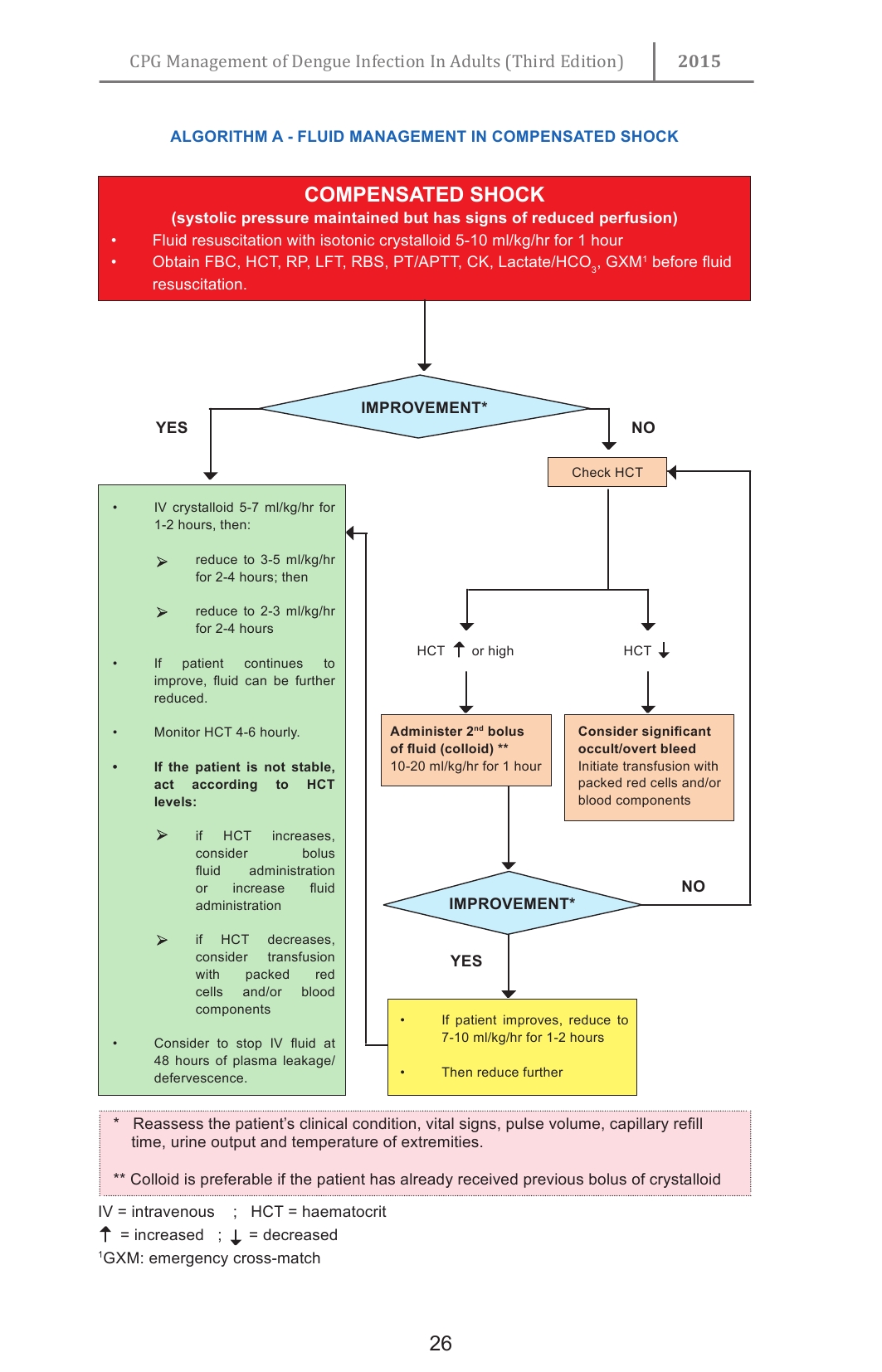
Algorithm A — Fluid management in compensated shock
Algorithm B — Fluid management in decompensated shock

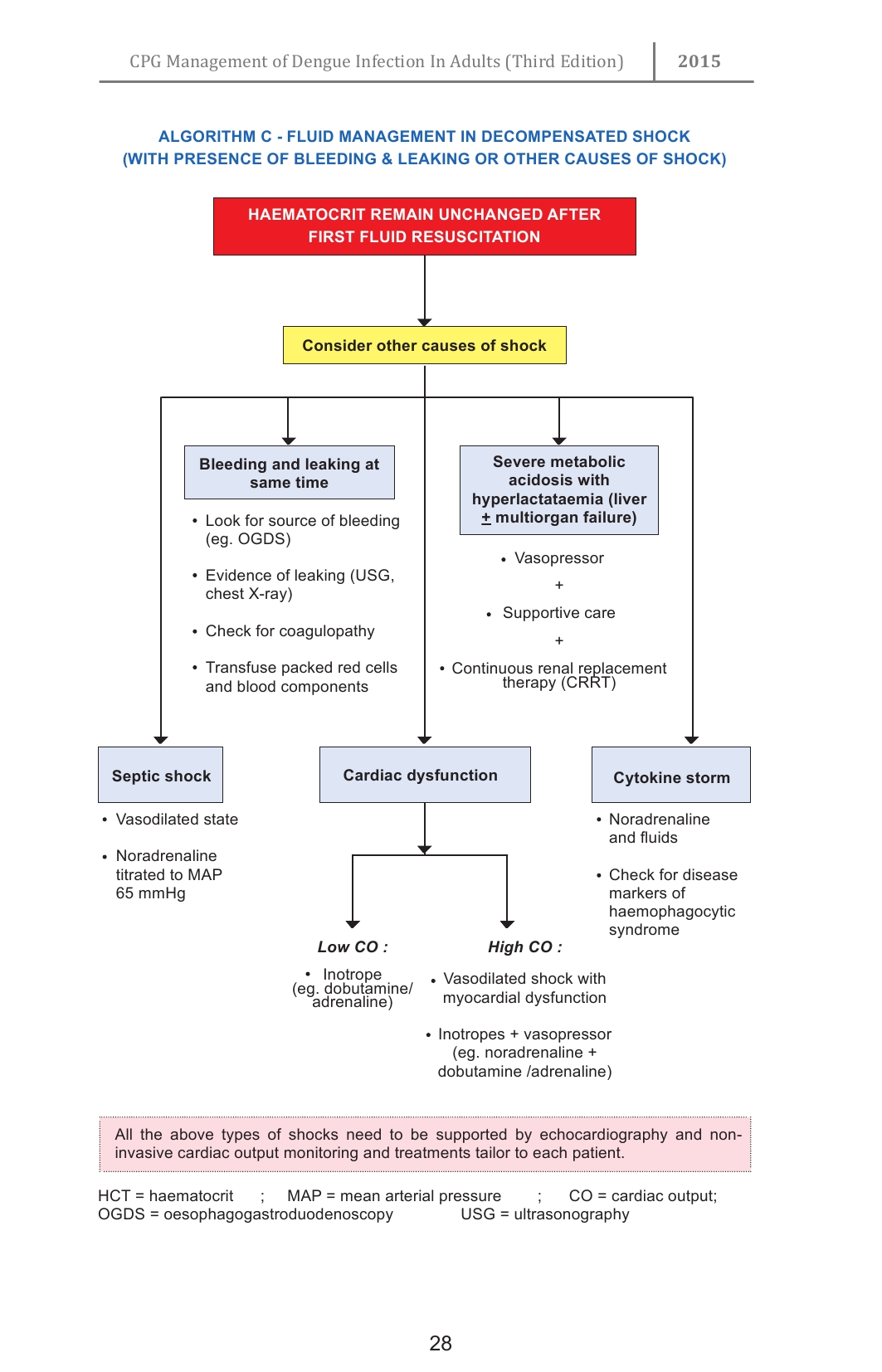
Algorithm C — Fluid management in decompensated shock (with presence of bleeding u0026amp; leaking or other causes of shock)
Common Q&A
--- This content is for premium members only. ---
Take Home Message
1. Remember to analyse the severity and anticipate the complications of dengue fever
2. CCTVR: shock can be missed if you do not touch the patient×CCTVRCCTVR — to assess features of shock by touching the peripheries
C: Color → Pale / mottled skin
C: CRT → CRT >2s
T: Temperature → Cold
V: Pulse Volume → Weak
R: Pulse Rate → Tachycardia
Related Posts: